
The six AI priorities buy-side firms agreed on at the 2025 Fixed Income Leaders Summit
The message was clear: AI isn’t a “someday” topic anymore. It’s operational. It’s measurable. And buy-side firms are ready.
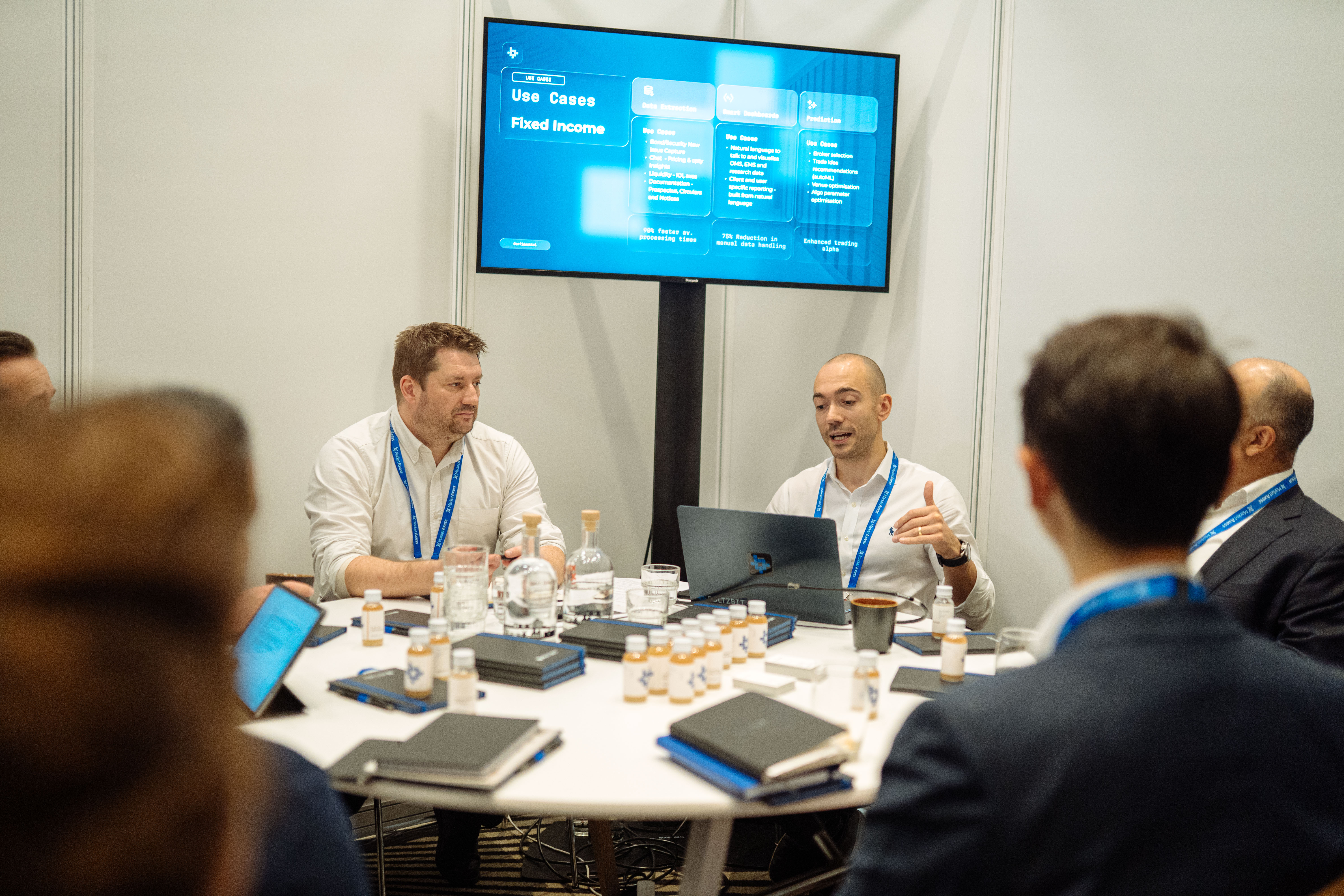
The message was clear: AI isn’t a “someday” topic anymore. It’s operational. It’s measurable. And buy-side firms are ready.
During the Boltzbit-hosted roundtables on FILS’ Innovation Day, a number of themes stood out clearly.
1) Big data reasoning
The point
Firms have no shortage of data but much of it is trapped in fragmented databases, documents, emails and chats. What desks now need is not more information but the ability for AI to read the market’s messy reality and surface insights at the speed decisions get made.
Why this is a theme
Data volume keeps growing while performance pressure rises. Advantage now comes from the reasoning layer, not just raw access.
What this means for the buy side
AI must extract meaning from unstructured information and deliver it directly into workflows, with clear reasoning behind every insight.
2) Accelerating engineering cycles
The point
Innovation slows when tech teams are consumed by maintenance: legacy code, manual documentation, onboarding new engineers. Firms want AI that reduces the burden on specialists and unlocks faster delivery without disruption.
Why this is a theme
The backlog is no longer a tech problem, it’s a business constraint.
What this means for the buy side
AI should support and extend existing systems: continuously improving with user feedback and reducing technical debt over time.
3) Stronger controls and governanace
The point
Data security and explainability are non-negotiable in trading contexts. As AI touches more proprietary data sets, ownership of data and transparency in outputs become essential.
Why this is a theme
Regulators, clients and risk teams are scrutinising model behaviour closely: where data lives, who has access to it and how the output was generated.
What this means for the buy side
AI must operate fully within the firm’s security perimeter, with governance, permissions and auditability embedded from the start.
4) Measuring what works
The point
Proof of concepts don’t scale unless they prove value. PMs and leadership expect measurable uplift, alpha generation, operational speed, error reduction, or AI doesn’t go into production.
Why this is a theme
Decision makers want outcomes, not experiments. Without performance data, AI adoption stalls.
What this means for the buy side
A short path to value is essential. Backtesting, monitoring and explainability must be built-in so results can be defended, scaled and repeated.
5) Deployment where traders already are
The point
Anything that pulls a trader away from the trading screen (OMS/EMS/PMS) introduces risk, slows execution and gets ignored. For adoption to happen, AI must show up exactly where decisions happen.
Why this is a theme
Front-office workflows are deliberately tight. Disruption slows execution and reduces P&L.
What this means for the buy side
AI must live natively within existing screens and user setup: one interface, one workflow, zero friction.
6) One screen for intelligence
The point
Information lives everywhere: positions, orders, risk, research, clients' activity. Traders want a single, trusted view that they can interrogate via natural language and act on instantaneously.
Why this is a theme
Fragmentation slows response times. Manual synthesis is expensive and error-prone.
What this means for the buy side
AI must unify insight into one application with real-time intelligence and fewer tools cluttering the process.